
Kronenberg Palace: The Warsaw Palace That Disappeared
2026-09-19
Lalka by Maciej Kawalski: A Journey into 19th Century Warsaw
2026-10-07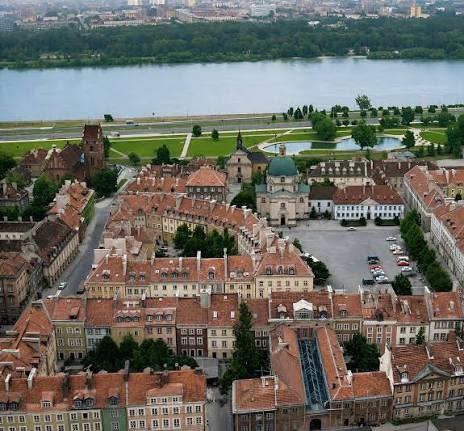
A Medieval Town Outside Warsaw
The story of New Town Warsaw goes back to the late Middle Ages.
In 1408, Duke Janusz I of Masovia formally established New Warsaw as a separate town. It developed outside the walls of Old Warsaw and had its own Vogt, council and town hall.
Why was a new town needed?
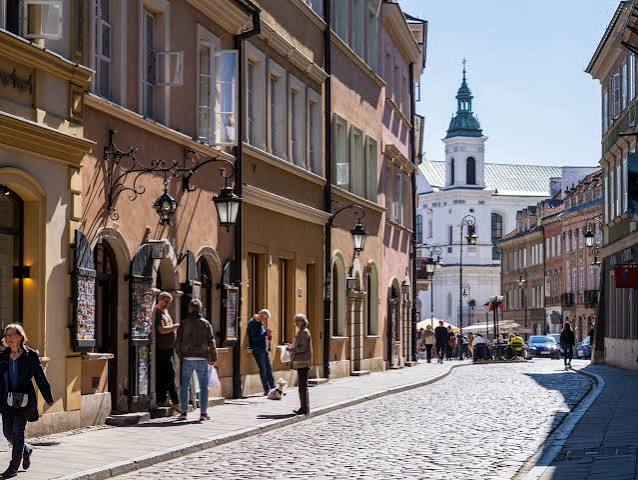
Warsaw was growing, and there was simply not enough room inside the medieval town. New Town developed along the road leading north from Old Warsaw, with today’s Freta Street becoming its main artery.
At the heart of the new settlement was its market square.
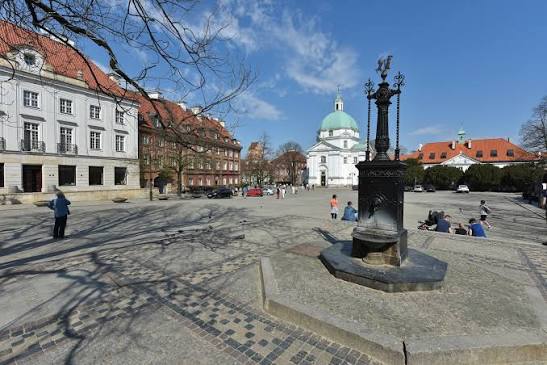
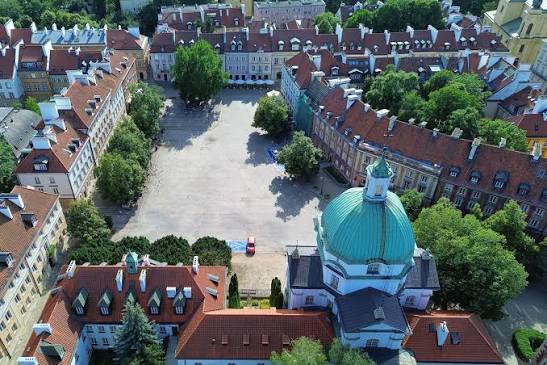
The original square was enormous by medieval standards, measuring roughly 140 by 120 meters. It was larger than the Old Town Market Square and was surrounded mainly by wooden buildings.
A town hall stood here from around the end of the 15th century. Fires, wars and changing architectural fashions gradually transformed the square.
One particularly destructive fire occurred in 1544, destroying much of the early wooden town.
But the medieval character of New Town was never completely forgotten.
Look at the Well in the Middle of the Square
Before moving on, take a look at the historic well in the center of the square.
You can see the coat of arms of New Town: a woman accompanied by a unicorn.
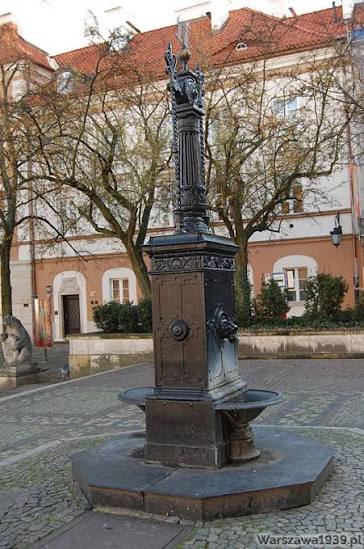
It is a small detail, but it tells an important story. New Town had its own identity for centuries, separate from Old Warsaw.
The well itself is not medieval — the present structure dates from the 19th century and was moved to the square during the post-war reconstruction. But the coat of arms connects it directly with the history of the old town.
This is exactly the kind of detail that is easy to miss if you simply walk through the square.
St. Casimir’s Church – The Baroque Landmark
Now look toward the eastern side of the square.
The large Baroque building with its distinctive dome is St. Casimir’s Church, also known as the Sacramentine Church.
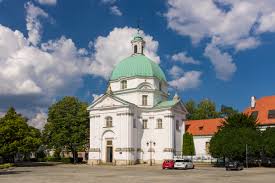
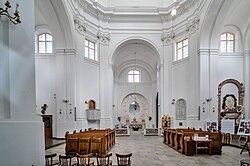
It is one of the most remarkable churches in Warsaw.
Its story begins in 1688, when Queen Marie Casimire (Maria Kazimiera Sobieska), the wife of King Jan III Sobieski, purchased the former Kotowski residence here.
She wanted to establish a monastery for the Benedictine Sisters of Perpetual Adoration of the Most Holy Sacrament.
The church was designed by the famous Dutch-born architect Tylman van Gameren and built between 1688 and 1692.
The monastery complex developed further during the 18th century. A new Baroque monastery building was erected in 1740, designed by Antonio Solari and financed by the Radziwiłł family.
The result was one of the most impressive Baroque complexes in Warsaw.
But the building you see today is also a powerful reminder of one of the darkest moments in the city’s history.
A Tragedy of the Warsaw Uprising
During the Warsaw Uprising of 1944, St. Casimir’s Church became a field hospital.
This made the building particularly vulnerable.
On 31 August 1944, German forces attacked the church. The building collapsed, killing around 1,000 people who were sheltering there, including wounded insurgents, civilians, priests and nuns.
The church was completely destroyed.
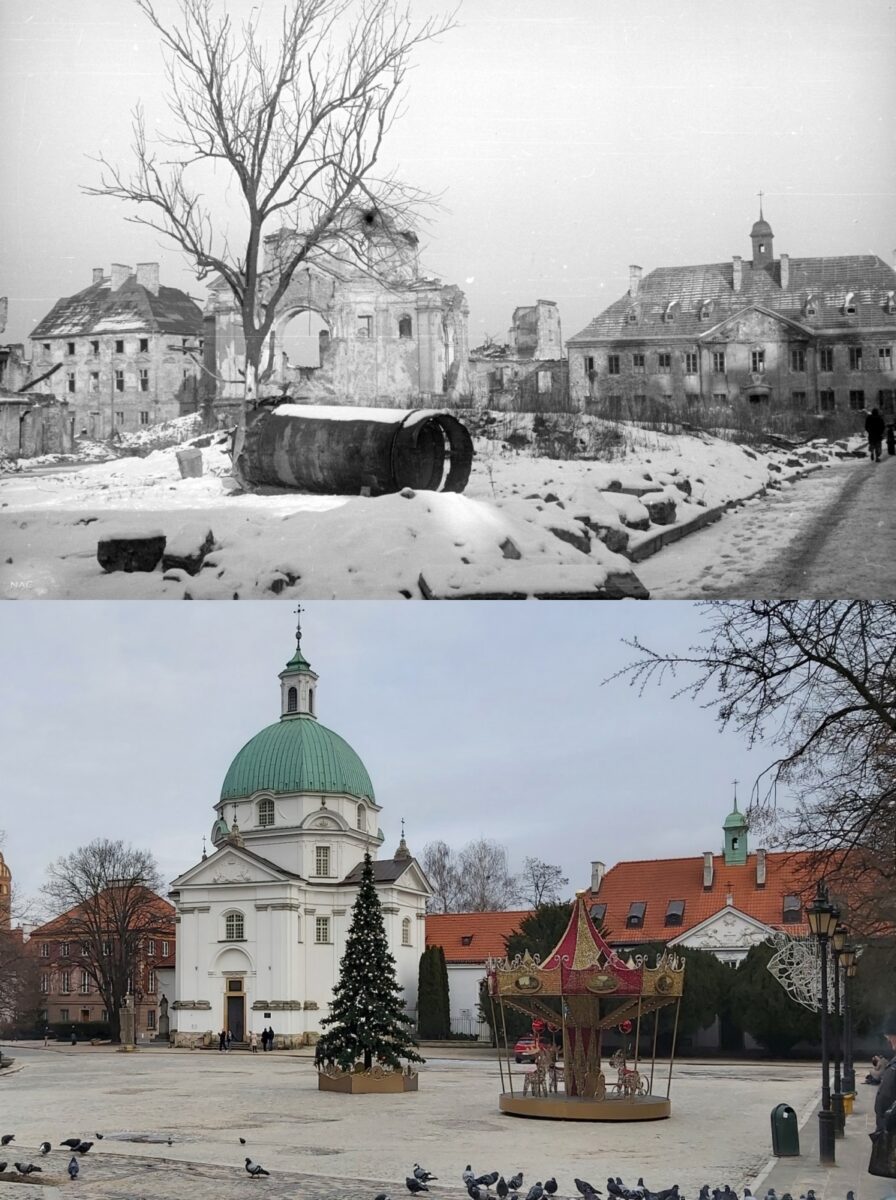
And it was not an isolated tragedy.
New Town was almost completely devastated during the Warsaw Uprising.
When you stand here today, it is difficult to imagine that almost everything around you was once a landscape of ruins.
New Town After the War
After 1945, Warsaw faced an extraordinary challenge: what should be rebuilt, and how?
The answer was not the same everywhere.
The Old Town was reconstructed with the intention of recreating its historic appearance as faithfully as possible.
New Town was treated differently.
Its reconstruction was more flexible. Some buildings were based on historical documentation, while others were newly designed using historical forms, particularly those inspired by 18th-century Classicism.
The reconstruction of the market square began in the early post-war years. The square itself reopened in 1954, while reconstruction of the surrounding area continued until around 1960.
This is why today’s New Town should not be thought of simply as a perfectly preserved medieval or 18th-century neighbourhood.
It is something more interesting: a post-war interpretation of historic Warsaw.
A Square That Has Changed Many Times
The appearance of New Town Market Square has changed repeatedly over the centuries.
By the end of the 18th century, most of the wooden buildings had been replaced by masonry houses.
Then came another major change.
In 1791, New Town was incorporated into Warsaw. Its independent town administration disappeared, and the old town hall eventually became unnecessary. The building was demolished in 1818.
During the 19th century, parts of the original market square were incorporated into streets, changing the shape of the space once again.
Before the Second World War, the square was surrounded by historic townhouses representing several different architectural periods.
Then came 1944.
And almost all of it disappeared.
What You Are Actually Seeing Today
This is one of the most interesting things to explain during a Warsaw walking tour.
The buildings around you look historic — and in terms of their architectural language, they certainly are.
But many of them are post-war reconstructions or new buildings inspired by historical architecture.
This is one of the reasons why New Town feels different from the Old Town.
The Warsaw Old Town reconstruction is internationally famous for its detailed recreation of the historic urban landscape. New Town has a somewhat looser and more varied character.
That makes it an excellent place to talk about one of the defining themes of Warsaw: how a city can be destroyed almost completely and then rebuilt while creating a new relationship with its own past.
Why Visit New Town Market Square in Warsaw?
If you are looking for things to do in Warsaw beyond the Old Town, put New Town Market Square on your list.
You can see:
- the historic New Town Market Square;
- the coat of arms of New Town on the central well;
- the magnificent St. Casimir’s Church;
- the former Sacramentine monastery;
- examples of post-war Warsaw reconstruction;
- and, just a few steps away, the historic buildings and atmosphere of Freta Street.
But the real attraction is the story.
In one relatively small area, you can follow the history of Warsaw from the medieval town, through the Baroque period, the 19th-century transformation of the city, the catastrophe of the Warsaw Uprising, and finally the remarkable post-war reconstruction.
And if you are exploring Warsaw with a private Warsaw tour guide, don’t simply cross the square on your way to the next attraction.
Stop at the well.
Look at the unicorn.
Then look at St. Casimir’s Church and remember that the beautiful buildings surrounding you are also part of a much larger story — the story of a city that was destroyed and rebuilt.